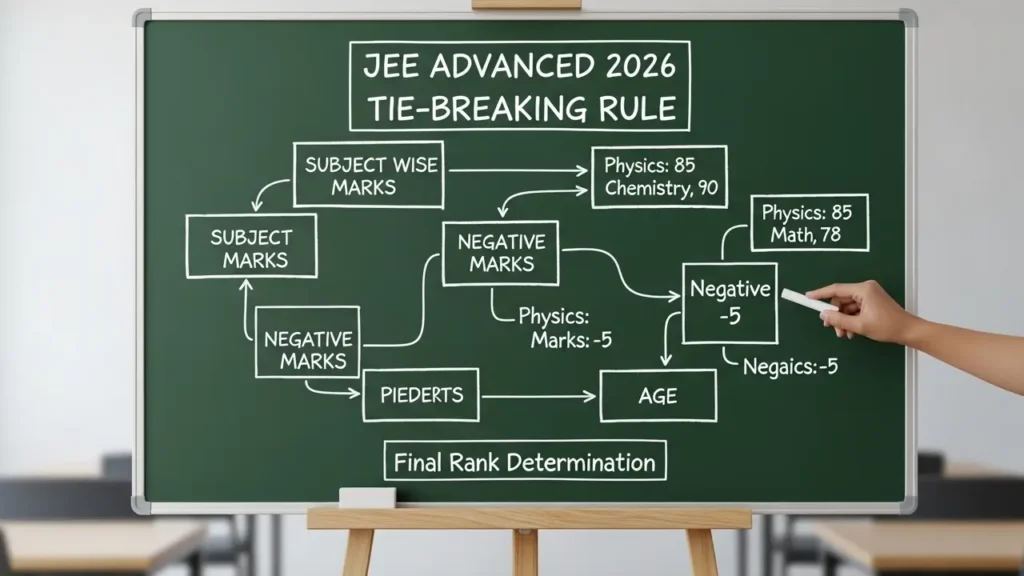
The JEE 2026 tie rule is an important concept for students preparing for one of India’s most competitive engineering entrance exams. Every year, thousands of candidates end up scoring identical marks, which creates a situation where ranks need to be assigned fairly and accurately. To ensure transparency and fairness, the National Testing Agency (NTA) follows a well-defined tie-breaking policy.
Understanding the JEE Main 2026 tie-breaking criteria is essential for aspirants because even a small difference in subject-wise scores can significantly impact your final rank. This detailed guide explains how the tie rule works, how marks are compared, and what factors determine your position when scores are equal.
Why the JEE Tie-Breaking Rule Matters
In a highly competitive exam like JEE, where lakhs of students appear, it is common for multiple candidates to secure the same total score. Without a structured system, it would be impossible to assign ranks fairly. This is where the JEE tie-breaking rule becomes crucial.

The rule ensures that every student is evaluated based on consistent academic parameters rather than random selection. It helps maintain merit-based ranking and ensures that deserving candidates receive the positions they have earned.
JEE 2026 Tie Rule for Paper 1 (B.E./B.Tech)
The JEE Main 2026 tie-breaking rule for Paper 1 follows a step-by-step approach. If two or more candidates score the same total marks, the ranking is decided based on the following priority sequence:
1. Higher Marks in Mathematics
The first comparison is made using marks obtained in the Mathematics section. The candidate with higher Mathematics marks is ranked higher.
2. Higher Marks in Physics
If Mathematics scores are equal, the next factor considered is Physics marks. The candidate scoring higher in Physics gets the better rank.
3. Higher Marks in Chemistry
If both Mathematics and Physics scores are identical, Chemistry marks are used as the next deciding factor.
4. Fewer Negative Responses
If all subject scores are the same, the number of incorrect answers is considered. The candidate with fewer negative responses is given preference.
5. Age Criteria
If the tie still persists, the older candidate is ranked higher.
This systematic approach ensures that the JEE ranking system remains logical and merit-driven.
JEE 2026 Tie Rule for Paper 2 (B.Arch & B.Planning)
The tie-breaking criteria for JEE Paper 2 differs slightly due to the structure of the exam. It includes additional components like drawing and aptitude tests.
For B.Arch and B.Planning aspirants, the ranking is determined using the following order:
1. Higher Marks in Aptitude Test
The aptitude section plays a crucial role in determining the rank.
2. Higher Marks in Drawing Test (for B.Arch)
Candidates with better performance in drawing are given preference.
3. Higher Marks in Mathematics
Mathematics remains an important factor even in Paper 2.
4. Fewer Negative Marks
Accuracy is considered by evaluating the number of incorrect answers.
5. Age Factor
Older candidates are given preference if all other criteria are identical.
Key Factors That Influence JEE Rank Beyond Total Score
Many students believe that only the total score matters, but the JEE 2026 ranking system considers multiple factors. These include subject-wise performance, accuracy, and consistency.
For example, a student with slightly higher Mathematics marks can outrank another student with the same total score. This highlights the importance of balanced preparation across all subjects.

Detailed Overview of Tie-Breaking Criteria
| Criteria Priority | Factor Considered | Description |
|---|---|---|
| 1 | Mathematics Marks | Highest priority for Paper 1 candidates |
| 2 | Physics Marks | Second-level comparison |
| 3 | Chemistry Marks | Third-level evaluation |
| 4 | Negative Responses | Fewer incorrect answers preferred |
| 5 | Age | Older candidate ranked higher |
How Percentile Scores Affect Tie Situations
In JEE Main, ranks are based on percentile scores rather than raw marks. The percentile indicates how a candidate performed compared to others in the same session.
However, even percentile scores can be identical. In such cases, the tie-breaking rule is applied. This ensures that the ranking process remains fair even when normalized scores match.
Importance of Accuracy in JEE 2026
Accuracy plays a major role in determining your final rank. Since the tie-breaking rule considers the number of incorrect answers, minimizing negative marking can give you a significant advantage.
Students should focus on solving questions carefully rather than attempting too many questions with low confidence. A higher accuracy rate can help break ties in your favor.
Common Misconceptions About JEE Tie Rules
There are several myths surrounding the JEE tie-breaking system. One common misconception is that rank allocation becomes random when scores are equal. This is not true.
The process is highly structured and based on clearly defined criteria. Another myth is that board exam marks influence the tie-breaker, which is no longer applicable in JEE Main ranking.
Tips to Avoid Tie Situations in JEE 2026
While ties cannot always be avoided, students can reduce their chances by improving subject-wise performance.
Focus on Mathematics: Since it is the first tie-breaker, scoring higher in Mathematics can give you an advantage.
Maintain Accuracy: Avoid unnecessary negative marking.
Balanced Preparation: Perform well in all three subjects.
Time Management: Attempt questions wisely during the exam.
How JEE Tie Rule Impacts College Admissions
Your JEE rank directly affects your chances of getting admission into top engineering colleges like IITs, NITs, and IIITs. Even a small rank difference can change your branch or institute.
This is why understanding the tie-breaking rule is important. It helps students strategize their preparation and maximize their chances of securing a better rank.
JEE 2026 Tie Rule: Final Thoughts
The JEE 2026 tie rule is designed to ensure fairness and transparency in the ranking process. It eliminates ambiguity and provides a clear method for resolving equal scores.
Students should not rely solely on total marks but also focus on subject-wise excellence and accuracy. A strong performance in Mathematics and fewer mistakes can make a significant difference in your final rank.
Frequently Asked Questions (FAQs)
1. What happens if two students score the same marks in JEE 2026?
If two students have the same score, the tie-breaking rule is applied based on subject-wise marks, accuracy, and age.
2. Which subject is most important in the tie-breaking rule?
Mathematics is given the highest priority in the tie-breaking process.
3. Does Class 12 percentage affect JEE ranking?
No, board exam marks are not considered in the JEE tie-breaking criteria.
4. Is negative marking important in tie-breaking?
Yes, candidates with fewer incorrect answers are ranked higher.
5. Can two students get the same rank in JEE?
No, the tie-breaking rule ensures that each student is assigned a unique rank.


Hi, I’m Arsam, the author and creator of MTPHA.I have a strong interest in smartphone technology and the automotive industry, and I enjoy exploring new innovations, features, and trends in these fields. Through this website, I share my knowledge, research, and personal insights to help readers stay informed and up to date.